Large Square Modern Contemporary Canvas Art of Dutch Shoes

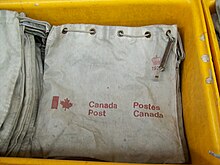
Crewman bag made of canvas


Canvas is an extremely durable plain-woven fabric used for making sails, tents, marquees, backpacks, shelters, as a support for oil painting and for other items for which sturdiness is required, also equally in such manner objects as handbags, electronic device cases, and shoes. It is as well popularly used past artists as a painting surface, typically stretched beyond a wooden frame.
Mod canvas is usually made of cotton or linen, or sometimes polyvinyl chloride (PVC), although historically it was made from hemp. It differs from other heavy cotton fabrics, such as denim, in being plain weave rather than twill weave. Canvas comes in two bones types: manifestly and duck. The threads in duck canvas are more than tightly woven. The term duck comes from the Dutch word for material, doek. In the United States, canvas is classified in two means: by weight (ounces per square thousand) and by a graded number system. The numbers run in contrary of the weight then a number 10 canvas is lighter than number 4. Sheet has become the most common support medium for oil painting, replacing wooden panels. Information technology was used from the 14th century in Italy, but only rarely. One of the earliest surviving oils on canvas is a French Madonna with angels from effectually 1410 in the Gemäldegalerie, Berlin.
The word "canvas" is derived from the 13th century Anglo-French canevaz and the Old French canevas. Both may be derivatives of the Vulgar Latin cannapaceus for "made of hemp", originating from the Greek κάνναβις (cannabis).[ii] [iii]
For painting [edit]

Canvas has become the most mutual support medium for oil painting, replacing wooden panels. It was used from the 14th century in Italia, just merely rarely. Ane of the primeval surviving oils on canvas is a French Madonna with angels from around 1410 in the Gemäldegalerie, Berlin. Its utilize in Saint George and the Dragon past Paolo Uccello in about 1470,[four] and Sandro Botticelli's Birth of Venus in the 1480s was even so unusual for the period. Large paintings for country houses were plainly more likely to be on canvas, and are peradventure less likely to have survived. It was a good deal cheaper than a panel painting, and may sometime indicate a painting regarded as less important. In the Uccello, the armour does not utilise silverish leaf, as other of his paintings do (and the colour therefore remains undegraded).[v] Another common category of paintings on lighter textile such as linen was in distemper or mucilage, ofttimes used for banners to be carried in procession. This is a less durable medium, and surviving examples such as Dirk Bouts' Entombment, in distemper on linen (1450s, National Gallery) are rare, and often rather faded in appearance.
Console painting remained more common until the 16th century in Italian republic and the 17th century in Northern Europe. Mantegna and Venetian artists were among those leading the change; Venetian sail sail was readily available and regarded as the best quality.
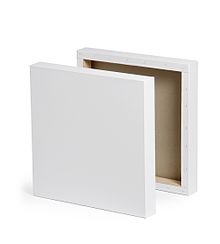
Sheet stretched on wooden frame
Sheet is commonly stretched across a wooden frame called a stretcher and maybe coated with gesso prior to being used to prevent oil paint from coming into direct contact with the sheet fibres which would eventually cause the canvas to disuse. A traditional and flexible chalk gesso is composed of lead carbonate and linseed oil, applied over a rabbit skin glue ground; a variation using titanium white pigment and calcium carbonate is rather brittle and susceptible to cracking. As lead-based paint is poisonous, care has to be taken in using it. Diverse culling and more than flexible canvas primers are commercially available, the most pop being a synthetic latex paint equanimous of titanium dioxide and calcium carbonate, bound with a thermo-plastic emulsion.
Many artists take painted onto unprimed canvass, such as Jackson Pollock,[6] Kenneth Noland, Francis Salary, Helen Frankenthaler, Dan Christensen, Larry Zox, Ronnie Landfield, Colour Field painters, Lyrical Abstractionists and others. Staining acrylic pigment into the fabric of cotton duck canvass was more than beneficial and less dissentious to the fabric of the canvas than the use of oil paint. In 1970 artist Helen Frankenthaler commented about her employ of staining:
When I offset started doing the stain paintings, I left big areas of canvas unpainted, I think, because the canvas itself acted as forcefully and equally positively as pigment or line or color. In other words, the very ground was part of the medium, so that instead of thinking of it as background or negative space or an empty spot, that area did non need pigment considering it had paint next to information technology. The thing was to decide where to leave it and where to make full information technology and where to say this doesn't need another line or another pail of colors. It's saying it in infinite.[vii]

Bleaching-fields covered with sheets of new-made textiles, probably linen, very maybe canvas, 1670s near Haarlem in holland
Early canvas was made of linen, a sturdy dark-brown fabric of considerable forcefulness. Linen is especially suitable for the use of oil paint. In the early 20th century, cotton sheet, often referred to every bit "cotton duck", came into use. Linen is equanimous of college quality cloth, and remains popular with many professional artists, especially those who work with oil paint. Cotton duck, which stretches more fully and has an fifty-fifty, mechanical weave, offers a more economical alternative. The advent of acrylic paint has greatly increased the popularity and use of cotton duck canvas. Linen and cotton derive from 2 entirely different plants, the flax plant and the cotton plant, respectively.
Gessoed canvases on stretchers are also available. They are bachelor in a variety of weights: light-weight is about 4 oz/sq yd (140 k/mtwo) or v oz/sq yd (170 grand/one thousandtwo); medium-weight is near 7 oz/sq yd (240 grand/g2) or 8 oz/sq yd (270 g/yard2); heavy-weight is well-nigh 10 oz/sq yd (340 g/g2) or 12 oz/sq yd (410 g/mii). They are prepared with ii or three coats of gesso and are fix for use straight away. Artists desiring greater control of their painting surface may add a coat or 2 of their preferred gesso. Professional artists who wish to work on canvas may prepare their own canvas in the traditional style.
One of the almost outstanding differences between modern painting techniques and those of the Flemish and Dutch Masters is in the preparation of the canvass. "Modern" techniques take advantage of both the sail texture as well as those of the pigment itself. Renaissance masters took extreme measures to ensure that none of the texture of the canvas came through. This required a painstaking, months-long procedure of layering the raw canvas with (unremarkably) atomic number 82-white paint, and so polishing the surface, and then repeating.[8] The final product had petty resemblance to fabric, only instead had a glossy, enamel-like cease.
With a properly prepared canvas, the painter will find that each subsequent layer of color glides on in a "buttery" style, and that with the proper consistency of awarding (fat over lean technique), a painting entirely devoid of brushstrokes can be achieved. A warm atomic number 26 is applied over a piece of wet cotton to flatten the wrinkles.
Canvas can as well exist printed on using offset or specialist digital printers to create canvas prints. This process of digital inkjet press is popularly referred to as Giclée. After printing, the canvas can exist wrapped effectually a stretcher and displayed.
For embroidery [edit]
Canvas is a popular base of operations material for embroidery such as cantankerous-sew together and Berlin wool work.[9] Some specific types of embroidery canvases are Aida material (also called Coffee canvas[10]), Penelope canvas, Chess canvas, and Binca sail.[11] [12] [13] Plastic canvas is a stiffer form of Binca sheet.[xiv]
Every bit a compound agent [edit]

Stretching canvass on a canoe
From the 13th century onward, canvas was used as a covering layer on pavise shields. The canvas was practical to the wooden surface of the pavise, covered with multiple layers of gesso and often richly painted in tempera technique. Finally, the surface was sealed with a transparent varnish. While the gessoed canvas was a perfect painting surface, the chief purpose of the canvas application may accept been the strengthening of the wooden shield corpus in a way similar to modern glass-reinforced plastic.
Splined sail, stretched sheet and canvas boards [edit]
Splined canvases differ from traditional side-stapled canvas in that canvas is attached with a spline at the rear of the frame. This allows the creative person to comprise painted edges into the artwork itself without staples at the sides, and the artwork can be displayed without a frame. Splined canvas tin be restretched by adjusting the spline.
Stapled canvases stay stretched tighter over a longer period of time, only are more hard to re-stretch when the need arises.
Canvas boards are made of canvas stretched over and glued to a cardboard backing, and sealed on the backside. The canvas is typically linen primed for a certain type of paint. They are primarily used by artists for quick studies.
Types [edit]
- Dyed canvas
- Fire-proof canvas
- Printed canvass
- Stripe sail
- Water-resistant canvas
- Waterproof canvas
- Waxed canvass
- Rolled canvas
Products [edit]
- Woods-and-canvas canoes (come across photo of canvas being stretched on a canoe)
- Bags, including coated sail (e.one thousand. Goyard)
- Covers and tarpaulins
- Shoes (due east.one thousand. Converse, Vans, Keds)
- Tents
- Martial arts uniforms (due east.grand. Tokaido, Shureido, Judogi)
- Canvas Prints
- Wrestling canvas, used in WWE and other Sports Entertainment promotions
See likewise [edit]
- Canvas print
- Eisengarn
- Marine canvas
- Plastic sail
- Salembaree
References [edit]
- Gordon, Dillian, National Gallery Catalogues (new series): The Fifteenth Century Italian Paintings, Volume one, 2003, ISBN 1857092937
- ^ "National Museum (Muzeum Narodowe)". www.warsawtour.pl. Archived from the original on 7 October 2013. Retrieved 20 October 2013.
the largest Polish painting "Battle of Grunwald" by Jan Matejko (426 x 987 cm).
- ^ "The Online Etymology Lexicon". Etymonline.com. Retrieved 2012-05-05 .
- ^ "Oxford Dictionaries". Oxford University Printing. Retrieved 2014-03-01 .
- ^ Gordon, 13
- ^ Gordon, xv
- ^ "Jackson Pollock – A Life". Theblurb.com.au. 2002-ten-04. Archived from the original on 2012-03-21. Retrieved 2012-05-05 .
- ^ De Antonio, Emile. Painters Painting, a Candid History of The Modern Art Scene 1940–1970, p. 82, Abbeville Press 1984, ISBN 0-89659-418-1
- ^ "Classical Oil Painting Technique". Cartage.org.lb. Archived from the original on 2012-03-01. Retrieved 2012-05-05 .
- ^ Cluckie, Linda (2008). The Rise and Autumn of Art Needlework: Its Socio-Economic and Cultural Aspects. Arena. p. sixty. ISBN978-0955605574.
- ^ Saward, Blanche C. (1887). Encyclopedia of Victorian needlework: Lexicon of needlework, Volume ane. Dover Publications. ISBN9780486228006.
Aida Canvas. — This material, introduced under the French name Toile Colbert, is a clarification of linen cloth. It is also chosen " Aida Material," and Coffee Canvas ( which meet), as well as " Fancy Oatmeal."
- ^ White, A. V. Principal Embroidery Stitches and Designs. Taylor & Francis.
- ^ Bendure, Zelma & Gladys (1946). America's fabrics: origin and history, manufacture, characteristics and uses. Macmillan Company. p. 616.
- ^ Morris, Barbara (2003). Victorian embroidery : an authoritative guide. Mineola, N.Y.: Dover Publications. p. 166. ISBN0486426092.
- ^ Goodridge, Paula (2009). Art activities : that are like shooting fish in a barrel to prepare and that children will beloved. Bedfordshire, UK: Brilliant Pub. p. 65. ISBN978-1905780334.
External links [edit]
 | Wikimedia Commons has media related to Canvass. |
 | Wait up sail in Wiktionary, the complimentary dictionary. |
Source: https://en.wikipedia.org/wiki/Canvas
0 Response to "Large Square Modern Contemporary Canvas Art of Dutch Shoes"
Post a Comment